I. Orders and Galois Connections
I.0. Review of ZFC
在这里, 我们先不对集合做非常严格的叙述, 只基于 ZFC 公理做极笼统的介绍. 笼统地讲, ZFC 构筑于一节逻辑, 集合论会用到的二元谓词 \(\in\) 和下面的公理 A.1 – A.9. 注意, ZFC 处理的所有对象都应当被理解为集合. 特别地, 集合的元素本身也是一个集合, 且集合 \(s\) 和仅含 \(s\) 的集合 \(\set{s}\) 是两码事.
- A.1 外延公理 (Axiom of Extensionality): 若两集合有着完全相同的元素, 则两集合相等.
- \(\forall x \forall y(\forall z(z \in x \Leftrightarrow z \in y)\Rightarrow x = y)\)
- 我们形式定义空集 \(\varnothing \edef \set{u \in X : u \neq u}\), 其中 \(X\) 是任意的集合.
- A.2 正则公理 (Axiom of Regularity): 任意非空集合, 至少包含一个与原集合不相交的元素. 此定义侧重于 "运算 (operation)". 另有侧重 "序 (order)" 的等价定义: 任意非空集都含有一个对从属关系 \(\in\) 极小的元素.
- 侧重运算的表述是在说, 对于一个非空集合 \(S\), 总存在一个元素 \(x\), 使得 \(x \cap S = \varnothing\). 即, 找不到一个元素 \(y\) 既属于 \(x\) 又属于 \(S\).
- \(\neg \exist y (y \in x \and y \in S)\)
- 侧重序的表述是在说, 对于非空集合 \(S\), 总存在一个元素 \(x\), 使得任何 \(S\) 中的元素 \(y\) 不能从属于 \(x\).
- \(\neg \exist y (y \in S \and y \in x)\)
- 该公理禁止了自我包含和无线递降链. \(A\in A\) 是不可能的; 集合的层级必然有终点. 当集合中有一个元素是空集, 那么空集一定是该集合对于 \(\in\) 的最小元, 也即与原集合不相交. 注意, 空集是所有集合的子集, 但不一定是某集合的元素. 需要区分 "包含" 和 "属于".
- A.3 配对公理 (Axiom of Pairing): 对任意的 \(x,y\), 存在集合 \(\set{x,y}\), 其元素恰好是 \(x\) 与 \(y\).
- \(\forall x \forall y \exist z \forall u (u \in z \Leftrightarrow (x=u \or x=v))\)
- 它是构建更大集合的基本步骤.
-
另外, 有序对的概念可以用配对公理来做. 因为集合\(\set{a,b}\)是没有顺序的, \(\set{a,b} = \set{b,a}\). Kuratowski 给出了 ordered pair 的定义: \((x,y) \edef \set{\set{x},\set{x,y}}\). 可以进一步定义积集: \(X \times Y \edef \set{(x,y) : x \in X, \ y \in Y}\).
-
A.4 分离公理模式 (Axiom Schema of Specification / Separation): 设 \(P\) 是关于集合的一个性质. 用 \(P(A)\) 表示集合 \(A\) 满足性质 \(P\). 那么, 对任意集合 \(X\) 和任意性质 \(P\), 存在 \(X\) 的一个子集 \(Y\) 包含了所有 \(X\) 中满足了性质 \(P\) 的元素. \(Y = \set{u \in X : P(u)}\).
- \(\forall x \exist y \forall u (u \in y \Leftrightarrow u \in x \and P(u))\).
- 在朴素集合论中, 我们认为一个性质 \(P\) 就定义了一个集合. 这会导致经典的罗素悖论: 我能不能构造一个不包含自己的集合? 分离公理模式的设立就是为了解决这类问题. 我们要求构建集合时, 必须从一个已知的集合中取元素. 但这显然会引发另一个问题, 溯流而上, 那个最大的集合是什么? 事实上, 我们需要引入一个断言: 存在一个不包含任何元素的集合, 即空集 \(\varnothing\). 想要构建自然数, 可以对空集使用幂集定理 (A.6), 得到 \(\set{\varnothing}\), 称它为 \(1\), \(\varnothing\) 则称为 \(0\). 随后, \(\set{\varnothing, \set{\varnothing}}\) 称为 \(2\)... 这样就构造出了所有有限的数学结构. 无穷公理 (A.7) 又说, 存在无穷集. 这样就可以构建无穷序数 \(\omega\) (见后文).
- A.5 并集公理 (Axiom of Union): 对任意集合, 存在相应的并集 \(\bigcup X \edef \set{u : \exist v \in X \text{ such that } u \in v}\)
- \(\forall X \exist U \forall x (x \in U \Leftrightarrow \exist Y(x\in Y \and Y \in S))\).
- 我们熟悉的 \(A \cup B\) 实际上是综合使用配对公理和并集公理的结果. 对于集合 \(A, B\) 首先构造集合 \(S = \set{A,B}\) (配对公理). 接着, 对 \(S\) 应用并集公理, 就得到定义 $A \cup B \edef \bigcup S = \bigcup\set{A,B} $.
- A.6 幂集公理 (Axiom of Power Set): 对任意集合 \(x\), 存在一个集合包含了 \(x\) 的所有子集 \(\mca{P}(x)\edef \set{u: u\sube x}\).
- 注意, 我们定义 \(z \sube x\) 为: \(\forall x \exist y \forall z(z \in y \Leftrightarrow \forall \omega(\omega\in z \Rightarrow \omega \in x))\).
- A.7 无穷公理 (Axiom of Infinity): 存在无穷集.
- \(\exist x(\varnothing \in x \and \forall y \in x(y \cap \set{y} \in x))\).
- 如上形式化构建的 \(x\) 称为归纳集. 在集合论中, 我们定义任意集合 \(u\) 的后继为 \(S(u)=u\cup\set{u}\). 也就是说, 归纳集对后继封闭.
- A.8 替换公理模式 (Axiom Schema of Replacement): 设 \(F\) 是一个以集合 \(X\) 为定义域的函数, 则存在集合 \(F(X) = \set{F(x) : x \in X}\). 用自然语言讲就是, 如果有一个集合 \(X\) 和一个对应规则 \(F\), 那么按此规则把集合里的每个元素都做替换, 生成的新元素也能组成一个集合. 或者更简单地, 函数的像也是一个集合.
-
\(\forall A(\forall x \in A \exist !y \vp(x,y)) \Rightarrow \exist B\forall y (y \in B \Leftrightarrow \exist x \in A \vp(x,y))\).
-
A.9 选择公理 (Axiom of Choice): 设有一族互不相交的非空集合, 我们总可以在每一个集合中选取一个元素, 组成一个新的集合.
- 该定理作为 ZFC 的 "C", 存在着争议. 不过暂时先不管它.
- \(\forall \mca{F}(\varnothing \in \mca{F} \Rightarrow \exist f (f:\mca{F}\to\bigcup \mca{F} \and \forall A \in \mca{F}(f(A)\in A)))\).
- 其中, \(\mca{F}\) 是由非空集合组成的族. \(f\) 被称为选择函数.
I.1 Orders
在一个由若干节点构成的系统中, 根据连接的性质和拓扑结构, 可以从两个维度来将其分类. 其一是作 无向 (Undirected) 和 有向 (Directed) 的区分, 其二是作 无环 (Acyclic) 和 带环 (Cyclic) 的区分. 一个重要的哲学洞察是, 逻辑本质上是无环的, 因此在数学与计算机科学中, 许多研究都聚焦于 有向无环图 (Directed Acyclic Graph, DAG). 尽管在生命系统中, 带环系统似乎是无处不在的.
I.1.1 Preorders
在集合论的视角中, 我们使用 "序关系 (Order Relations)" 来捕捉这些系统的特性. 一个比较基本的序关系是 预序关系 (Preoreder Relations). 可以试着想象, 如果要给一个集合 \(X\) 赋予一个序关系 \(\leq\), 最简单, 不会导致矛盾的约束条件是什么.
Definition 1.1.1 (Preorders)
我们定义集合 \(X\) 上的预序关系是 \(X\) 上的一个二元关系, 用 \(\leq\) 标记, 并且满足如下性质:
- 反身性 (Reflexivity): \(x \leq x\), for all \(x \in X\);
- 传递性 (Transitivity): If \(x\leq y\) and \(y \leq z\), then \(x \leq z\).
特别地, 如果 \(x \leq y\) 且 \(y \leq x\), 我们称 \(x,y\) 等价 (Equivalent), 一般记作 $x \sim y $. 具有预序关系的 set-relation pair \((X, \leq)\) 称为 预序 (preorder). 也就是说, 等价关系就是具备了对称性的预序关系. 等价关系的定义如下给出:
Definition 1.1.2 (Equivalence)
我们定义集合 \(A\) 上的等价关系是 \(A\) 上的一个二元关系, 用 \(\sim\) 标记, 并且满足如下性质:
- Reflexivity: \(a \sim a\), for all \(a \in A\);
- Symmetry: \(a \sim b\) \(\Leftrightarrow\) \(b \sim a\), for all \(a, b \in A\);
- Transitivity: if \(a \sim b\) and \(b \sim c\) then \(a \sim c\), for all \(a, b, c \in A\).
Example 1.1.3 (Discrete Preorders)
我们常说, 集合是无序的. 用本章的语言讲, 所有的集合 \(X\) 都可被视作一个离散的预序 \((X, \leq)\). 首先, 我们朴素地定义 \(x\leq x, \ \forall x \in X\).
接下来, 需要回顾对 "relation" 的定义: 集合 \(A\) 到 \(B\) 的一个二元关系 \(R\) 是笛卡尔积 \(A \times B\) 的一个子集. 若 \((a,b) \in R,\ a\in A,\ b \in B\), 我们就称 \(a\) 和 \(b\) 有 "关系", 记作 \(aRb\).
因此, 如果我们定义集合 \(X\) 上的 \(\leq\) 关系为 \(\{ (x,x) \mid x \in X \}\), 即任意元素只和自身有 \(\leq\) 关系, 那么 \((X,\leq)\) 就是一个预序, 且是最稀疏的预序. 到这儿我们就不再装模作样地用 \(\leq\) 了, 直接用等号就好, 即任一集合天然蕴含一个最稀疏的预序 \((X, =)\)
Example 1.1.4 (Codiscrete Preorders)
同样地, 任一集合也天然地蕴含一个最密集的预序, 任取两个元素都具有 \(\leq\) 关系. 也即, 对集合 \(X\), 构造关系 \(\leq\edef X \times X \sub X \times X\). 我们称这样的预序为 Codiscrete Preorders. 此处 "co-" 当取 "反" 义.
Example 1.1.5 (Booleans)
对于 booleans \(\mathbb{B} = \{ \false,\ \true \}\), \(\false \leq \true\), 也构成一个预序.
Definition 1.1.6 (Partial Orders and Skeletal Preorders)
Preorders 的信息存在冗余, 互相等价的元素可以兼并为一. 执行完这个操作, 我们就得到了 偏序 (Partial Orders, Posets), 它需要满足以下条件:
- Reflexivity: \(x \leq x\), for all \(x \in X\);
- Transitivity: If \(x\leq y\) and \(y \leq z\), then \(x \leq z\);
- Skeletality: \(x \sim y\) implies \(x = y\).
由于第三个条件在范畴论中被称为 skeletality, partial orders 也被叫做 skeletal preorders.
Remark 1.1.7
我们总喜欢把集合论关于序 (Orders) 的语言与图 (Graphs) 的语言结合起来. 因此接下来给出 Graphs 的定义.
Definition 1.1.8 (Graphs)
A graph \(G = (V, A, s, t)\) consists of a set \(V\) whose elements are called vertices, a set \(A\) whose elements are called arrows, and two functions \(s,t : A \to V\) known as the source and targets respectively. Given \(a \in A\) with \(s(a) = v\) and \(t(a) = w\), we say that \(a\) is an arrow from \(v\) to \(w\).
Example 1.1.9
举个例子. 在四个 Vertices \(V = \{ 1, 2, 3, 4 \}\), 画五个 Arrows \(A = \{ a, b, c, d, e \}\); 每个箭头的 source 和 target 分别由函数 \(s\) 和 \(t\) 给出.
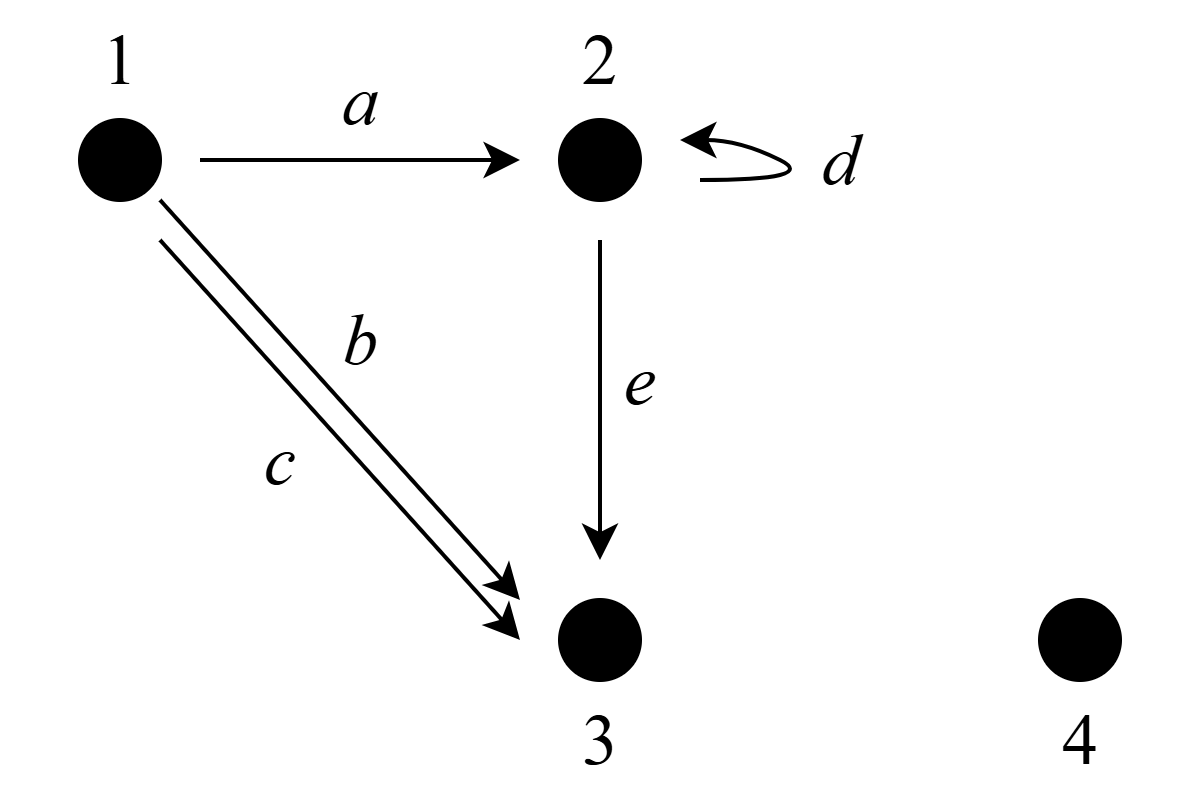
| Arrows | Source \(s(a) \in V\) | Target \(t(a) \in V\) |
|---|---|---|
| \(a\) | 1 | 2 |
| \(b\) | 1 | 3 |
| \(c\) | 1 | 3 |
| \(d\) | 2 | 2 |
| \(e\) | 2 | 3 |
注意, 虽然没有 4 到 1, 2, 3 的路径, 但是 4 到 4 自身的路径是存在的, 只是我们称该路径的长度为 0. 同时, 1 到 2 有无穷多条路径, 因为可以在 2 处通过 \(d\) 打转任意次.
Remark 1.1.10
我们总可以构建一个 Hesse 图 \(G = (V,A,s,t)\) 和一个 preorder 之间的映射关系, 而且它至少是个满射, 也就是说任意的 Preorder 都能找到一个对应的 Graph. 以 Example 1.9 为例, 该 Graph 对应的 Preorder \((P, \leq)\) 可以规定如下:
注意, 从 Graph 到 Preorder 的映射不是单射, 这是因为冗余边的存在, 例如 Example 1.9 中 1 到 3 有两个箭头, 但这在 Preorder 中是体现不出来的.
Definition 1.1.11 (Total Order)
Total Order (全序) 任意两个元素都 "可比较" 的 Preorder.
- Reflexivity: \(x \leq x\), for all \(x \in X\);
- Transitivity: If \(x\leq y\) and \(y \leq z\), then \(x \leq z\);
- Comparability: For all \(x,y\), either \(x\leq y\) or \(y\leq x\).
Remark 1.1.12
Discrete preorder 并非任意两个元素都不可比较. Reflexivity 保证了自身对自身是可比较的.
Remark 1.1.13 (Partition from Preorder)
对于一个集合, 我们可以做若干种 partition. 我们称, a partition \(P\) is finer than a partition \(Q\) if, for every part \(p \in P\), there is a part \(q \in Q\) such that \(A_p \subseteq A_q\). 我们可以说 \(Q\) is coarser than \(P\) (更粗糙). 同时, 集合 \(A\) 上的 partition 可以被看作是一个 \(A\) 上的满射. 即, 将每个 \(A\) 中的元素映射到对应分类的盒子, 所有盒子的编号构成 partition set \(P\).
从满射的角度看, 我们也可以说 \(f : A \twoheadrightarrow P\) is finer than \(g : A \twoheadrightarrow Q\) if there is a function \(h : P \to Q\) such that \(f \fatsemi h = g\).
Example 1.1.14
对任意集合 \(S\) 都有一个最粗糙的 partition, 将所有元素都打包为一部分, 其对应满射 \(!: S \to \{1\}\), 我们称之为 unique function. 同样地, 对任意集合 \(S\) 也有最精细的 partition, 每个元素都分开打包, 其对应满射 \(\text{id}_S : S \to S\), 即 identity function.
Definition 1.1.15 (Upper Sets)
Given a preorder \((P,\leq)\), an upper set in \(P\) is a subset \(U\) of \(P\) that satisfying the condition that if \(p \in U\) and \(p \leq q\), then \(q \in U\). 也就是说, 如果一个元素在 upper set 中, 那么所有比它大的也在其中. 记 \(\mathsf{U}(P)\) 为所有 P 上的 upper set 构成的集合. 我们可以自然地给这个集合 \(\msf{U}\) 一个序关系 \(\leq\): 对于 \(U, V \in \msf{U}\), 若 \(U \subseteq V\), 则 \(U \leq V\). 虽然这从自然语言的观点来看有点脱裤子放屁, 但 \(\subseteq\) 和 \(\leq\) 在数学上的意义是大为不同的.
Proposition 1.1.16
The preorder of upper sets on a discrete preorder on a set \(X\) is simply the power set \(\msf{P}(X)\).
我认为书中这样讲会引起混淆, 这句话缩句结果是 The preorder is the set, 让人觉得略摸不着头脑. 不过就当它是简单的说法好了.
Definition 1.1.17 (Product Preorder)
Given preorders \((P,\leq)\) and \((Q,\leq)\), we define a preorder structure on the product set \(P \times Q\) by setting \((p,q) \leq (p^\prime, q^\prime)\) if and only if \(p\leq p ^\prime \land q \leq q^\prime\). We call this the product preorder.
Definition 1.1.18 (Opposite Preorder)
Given a preorder \((P,\leq)\), we define the opposite preorder \((P, \leq^{\t{op}})\) to have the same set of elements, but with \(p \leq^{\t{op}} q\) if and only if \(q\leq p\).
I.1.2 Monotone Maps
接下来考察多个集合 / Preorders 之间的关系. 集合之间可以由映射联系, 而性质比较好的映射应当是保序的.
Definition 1.2.1 (Monotone Maps)
A monotone map between preorders \((A, \leq_A)\) and \((B,\leq_B)\) is a funtion \(f : A \to B\) such that, \(\forall x,y\in A\), if \(x\leq_A y\) then \(f(x)\leq_B f(y)\).
Proposition 1.2.2
对于一个 preorder \((P,\leq)\), 考察映射 \(\msf{U}(P) \to \msf{P}(P)\), 由 proposition 1.16, 当 \(\msf{U}\) 中的每个集合被映射到 \(\msf{P}\) 中的自身, 该映射就是一个 monotone map.
Proposition 1.2.3 (Yoneda Lemma)
Let \((P,\leq)\) be a preorder. Then:
- The set \(\uparrow p \edef \{ p^\prime \in P\ \mid p \leq p^\prime \}\) is an upper set, for any \(p \in P\).
- The map \(\uparrow\ :\ P^{\t{op}} \to \msf{U}(P)\) is a monotone map.
- \(p \leq p^\prime\) in \(P\) if and only if \(\uparrow (p^\prime) \subseteq\) \(\uparrow (p)\).
这实际上传递了一个思想: knowing an element \(p\) 和 knowing its upper set \(P\) 是等价的. 也就是说, 孤立的元素与元素之间的关系可以互相转化.
Proposition 1.2.4 (Pullback)
Any surjective funciton \(f : X \twoheadrightarrow Y\) induces a monotone map \(f^* : \msf{Prt}(Y) \to \msf{Prt}(X)\), going "backwards". It is defined by sending a partition \(s : Y \twoheadrightarrow P\) to the composite \(f \fatsemi s : X \twoheadrightarrow P\).
这段话有些难以理解, 我们一步步来. 由于范畴论关心态射, 我们考虑将以满射的形式看待 partition. 首先, \(f\) 作为一个满射, 是 \(X\) 上的一个 partition, \(f \in \msf{Prt}(X)\). 接下来, 我们再通过满射 \(s\) 对 \(Y\) 进行一次 partition, \(s \in \msf{Prt}(Y)\). 若将 \(f\) 与 \(s\) 复合, 就可以自然地得到一个 \(X\) 上的新的 partition, 且 \(f \fatsemi s\) is finer than \(f\). 因此我们说, Y 上的 partition \(s\) 会自然地产生一个 \(X\) 上的 partition \(f \fatsemi s\), 这便是由 \(f\) 确定的, 或者说诱导的一个映射 \(f^* : \msf{Prt}(Y) \to \msf{Prt}(X),\ s \mapsto f \fatsemi s\). 那么, 为什么这个操作叫 "pullback" 呢? 因为按理说我们是要将一整块带骨肉 \(X\) 细细切作臊子 \(P\), 各种 partition 操作都是直接做在 \(X\) 上的; 但我们这里引入了一个中间态 \(Y\), 先把大块带骨肉 \(X\) 用 \(f\) 切成若干小块 \(Y\), 再对这些小块做不同的操作 \(s\), 例如不见半点肥的, 不见半点瘦的, 莫要见一丁点肉. 结果对 \(Y\) 的操作竟 "反作用" 于 \(X\) 身上. \(Y\) 到 \(X\) 的反向即为 pullback 义.
Proposition 1.2.5
- For any preorder \((P, \leq_P)\), the identity function is monotone.
- If \((Q, \leq_Q)\) and \((R, \leq_R)\) are preorders and \(f : P \to Q\) and \(g : Q \to R\) are monotone, then \((f \fatsemi g) : P \to R\) is also monotone.
Definition 1.2.6 (Dagger Preorder)
Let \((P,\leq)\) be a preorder. We say \((P, \leq)\) is a dagger preorder if \(\forall p, q \in P,\ p \leq q \Rightarrow p \leq q\).
在预序的语境下, dagger condition 和 equivalence 的 symmetry condition (Definition 1.2) 是相同的. 我们在后面还会看到 dagger 在范畴论中的定义, 从而理解为什么要定义这么个新概念.
Proposition 1.2.7
A skeletal dagger preorder is just a discrete preorder, and hence can be identified with a set.