\[
\newcommand{\bs}{\boldsymbol}
\newcommand{\bsX}{\boldsymbol{X}}
\newcommand{\bf}{\mathbf}
\newcommand{\msc}{\mathscr}
\newcommand{\mca}{\mathcal}
\newcommand{\T}{\text{T}}
\newcommand{\rme}{\mathrm{e}}
\newcommand{\rmi}{\mathrm{i}}
\newcommand{\rmj}{\mathrm{j}}
\newcommand{\rmd}{\mathrm{d}}
\newcommand{\rmm}{\mathrm{m}}
\newcommand{\rmb}{\mathrm{b}}
\newcommand{\and}{\land}
\newcommand{\or}{\lor}
\newcommand{\exist}{\exists}
\newcommand{\sube}{\subseteq}
\newcommand{\lr}[3]{\left#1 #2 \right#3}
\newcommand{\intfy}{\int_{-\infty}^{+\infty}}
\newcommand{\sumfy}[1]{\sum_{#1=-\infty}^{+\infty}}
\newcommand{\vt}{\vartheta}
\newcommand{\ve}{\varepsilon}
\newcommand{\vp}{\varphi}
\newcommand{\Var}{\text{Var}}
\newcommand{\Cov}{\text{Cov}}
\newcommand{\edef}{\xlongequal{def}}
\newcommand{\prob}{\text{P}}
\newcommand{\Exp}{\text{E}}
\newcommand{\t}[1]{\text#1}
\newcommand{\N}{\mathbb{N}}
\newcommand{\Z}{\mathbb{Z}}
\newcommand{\Q}{\mathbb{Q}}
\newcommand{\R}{\mathbb{R}}
\newcommand{\C}{\mathbb{C}}
\newcommand{\versionofnewcommand}{\text{260125}}
\]
Renewal Process
Poisson process has independent exponentially distributed holding times, while Renewal theory generalizes the Poisson process for arbitrary holding times, in which these holding times are i.i.d. and have finite mean.
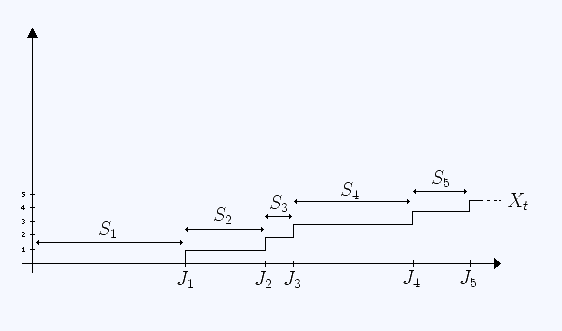
Let \((S_i)_{i>1}\) be a sequence of positive i.i.d. random variables with finite mean: \(0<E[S_i]<\infty\). And \(S_i\) is referred as the \(i\)-th holding time.
Therefore we can also define the \(n\)-th "jump time":
\[
J_n=\sum_{i=1}^n S_i
\]
and the intervals \([J_n,J_{n+1}]\) are called renewal intervals.